Posts

Showing posts with the label kinaesthetic learning

Make it real - the glory of in-lesson extra-curricular activities

Image
"Why do we have to learn this, sir?" "Miss? How will this help us in the real world?" The questions students ask in class are often the barometer of their engagement levels. The ones above, which are perhaps sadly familiar to those forced to teach obscure sonnets or niche equations by curriculum designers, are definitely NOT indicative of an engaged class. Here's where offering extra-curricular activities comes in: they are the bridge between the theoretical and the practical. They show students the real-world applications of the knowledge and skills they are acquiring. They give the students the answer to the "Why?" and "What's in it for me?" questions. Extra-curricular activities boost engagement. Now, let me make something clear: Extra-curricular activities do NOT have to take place outside of lessons.  I've seen looks of blank misunderstanding in schools when I've said this before, so I'll explain. I'm all in favour o...

Running dictations - develop recall skills... and fitness!

Image
 My PE colleagues are constantly griping at how student fitness is way down, especially since COVID, so here's a fun activity to help your students boost their cardio!  This is an old one (I got it from the legendary Gerard McLoughin at IH Barcelona) and it's great for waking your students up.  Put students into pairs (maybe threes, but big teams don't really work). Around the room (or at the end of the corridor, or outside) put up small pieces of key information you need the students to know. One partner runs to the first, memorises it, runs back, dictates it. Then they switch roles, like a relay. Spacing out the information avoids queues and crashes. Not only is this great for cardio, but you are helping students build their memorization and recall skills, both crucial for exam success (not that I'm a fan of exams as a form of assessment, but they are the reality of much of the educational landscape). More immediately, exercise creates endorphins, which is a massive m...

Drama - a tool for engaging students in any subject

Image
OK, so I'm an English teacher, thus it's pretty easy to get drama into the class. However, I'm not just talking about acting out the texts we study.  Oh no.  Do you have to teach your students to use the passive voice?  OK, so after you have taught the form of the grammar point, set up a crime scene in class, and have them role-play being CSI, awarding points for every correct usage of the passive (e.g. "Buzz Lightyear may have been stabbed with the highlighter sir"). Yet, these kind of role-plays aren't limited to the Language departments. I was doing some training in a bilingual school outside Madrid and persuaded the Geography teacher to give this ago. Walking down the corridor the next day, he dashed out of his room, dragged me in and I was treated to a dramatic rendering of weather patterns: some students were playing the cold front, others area of high pressure, still more storm clouds. It was amazing! Forget the students: I swear I learned more about w...

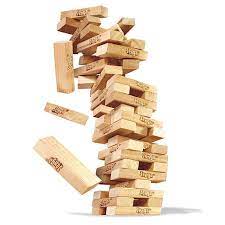
Jenga! - a metaphor for how writers use tension

Image
 I love finding ways to get games into the classroom (if you've read any of my other posts, you may have noticed). It is a great way to immediately amp up the students' engagement and energy levels. Many of the others I've written about - beep, bingo, taboo - can work in any subject. This one, I'm afraid, is purely for those Literature teachers among us... Jenga is a tense game. Therefore, I use it as a metaphor for tension in a text. I literally get the students to play Jenga as we read a tense moment of a text. Favourite moments for this include: Romeo & Juliet Act 3 Scene 5; the bit with Candy's dog in Of Mice and Men ; and when Fi gatecrashes the wedding in KE Salisbury's the face that pins you . As I'm reading I call people up to take a turn. The other students will get massively distracted, but at this point you pause (maybe while a student has half pulled out a brick) and ask the students if they are enjoying the lesson. "Yes!" they ...