Posts

Showing posts with the label engagement

Recommended reading: Ian Gilbert's "Essential Motivation in the Classroom"

Image
  My first post-PGCE school used to gift books on education to teachers (a great policy, one I try to continue). One day, Matt Butler handed this to me. I read it cover to cover and in typical try-to-run-before-you-can-walk enthusiasm (yep, I was one of those NQTs) I tried to institute nearly everything in it. Of course that didn't work. However, some ideas did stick and distilled down to become a core part of my classroom practice. The importance of the plenary. How vital it is to show students WHY they need to learn what you want them to. The way personal relationship can be catalysts for (re)engaging students' interests and passions.  Every couple of years I would re-read it, photocopy chapters to give to student teachers or NQTs I was mentoring. Much of the advice and ideas are timeless and, even when they have become such an ordinary part of classroom teaching that they seem obvious, it was always refreshing (in every sense of the word) to explore again the rationale beh...

Cluedo - a fun and engaging way to teach the passive voice

Image
 Ok, here's a blog post strictly for Foreign Language teachers: possibly my favourite use of board games in the classroom - using Cluedo* to teach the passive! * Clue for US readers. It may be mildly morbid, but having students play this game (ideally in 3s or 4s) is a great way to have them practise the target language: "I think Dr Black was killed with the gun in the kitchen by Professor Plum." "I suspect Dr Black was murdered with the knife in the dining room by Ms Scarlet." Up the ante by making them mix in modals of hypothesis: "I believe Dr Black may have been killed with the rope in the living room by Reverend Green." Plus, if you want to be really gruesome, you can always introduce the weapon-specific verbs: stab, shoot, strangle, bludgeon, etc.  I like to start off the lesson in role as a police officer, miming locking the door, announcing that there has been a murder and that nobody is leaving until the culprit has been found. A game of ta...

Pick your passion - inspire and engage students by teaching what inspires you

Image
There is nothing worse than observing a lesson where the teacher is clearly apathetic about what they are teaching. They aren't engaged, and so funnily enough the students are not engaged.  So here is my plea to curriculum designers and heads of faculty everywhere: as far as possible, allow teachers to teach their passions. Not only is this empowering for teachers, the positive knock-on effects will translate into more engaged students and better outcomes. Hattie measures teacher credibility as having a 0.9 effect size on students progress, just outside the top ten. I would argue that allowing teachers to teach what they are passionate about, therefore probably more knowledgeable about, will increase teacher credibility with students.  I've been doubly lucky. Firstly, as a language teacher, any song, film, article, comic, play, poem or piece of writing is a potential stimulus text for teaching. I can, and do, pick whatever interests me (a recent lesson involved me having stud...

Make it real - the glory of in-lesson extra-curricular activities

Image
"Why do we have to learn this, sir?" "Miss? How will this help us in the real world?" The questions students ask in class are often the barometer of their engagement levels. The ones above, which are perhaps sadly familiar to those forced to teach obscure sonnets or niche equations by curriculum designers, are definitely NOT indicative of an engaged class. Here's where offering extra-curricular activities comes in: they are the bridge between the theoretical and the practical. They show students the real-world applications of the knowledge and skills they are acquiring. They give the students the answer to the "Why?" and "What's in it for me?" questions. Extra-curricular activities boost engagement. Now, let me make something clear: Extra-curricular activities do NOT have to take place outside of lessons.  I've seen looks of blank misunderstanding in schools when I've said this before, so I'll explain. I'm all in favour o...

Domino praise - (re)engaging students through positivity

Image
For many teachers, some teaching tools are so ingrained or instinctive we just take them for granted. This is one such case, which I only realised wasn't completely obvious when observing a new teacher the other day... Picture the scene: the class is working to find evidence in a text or working through a series of Maths/MFL exercises (this could be any subject at this point). Many are working diligently, but others aren't. There's some off topic chat, nothing major, nothing really disruptive, but these students are not engaged in the task. They aren't learning. To me, which getting on for 20 years of experience in education, there's a simple fix, yet the teacher remained seated and tried to manage this by tackling those who are off topic.  Ok, that might work. But maybe they are disengaged because they don't know how to approach the task or what's in it for them. So, rather than go with stick, provide a carrot. Get up. Immediately that will refocus some stu...

Show them the success part 2 - personal learning checklists

Image
 Success is a great motivating factor, and students who are motivated are usually more engaged in the lesson and their learning. However, it's important (I feel) that students don't just equate success with grades. After all, loads of people (including teachers!) have been successful in life without scoring top marks.  This is where personal learning checklists can come in. Using these at the beginning, middle and end of a unit (and perhaps other points between) allow students to see the progress that they have made, the successes that they have had.  Here's an example, if you aren't sure what I'm talking about: It is literally a list of skills you intend for students to acquire or develop during the unit. Students self-assess themselves, perhaps using a colour code (red, amber, green) or letter code (d - developing, s - secure, e - expert), returning later to review their own progress. Thus they can then see how your teaching input has lead them to acquire new s...

Show them the success part 1 - a means of motivation

Image
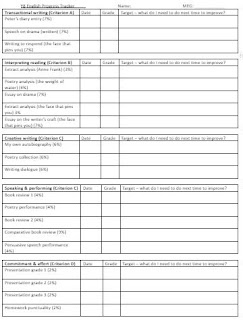
Back when I was a new teacher, I was having trouble motivating a class. My very wise mentor, Chris Campbell, told me to show them the success . I started doing this, and I noticed engagement go up, behaviour improve and students progressing. Now showing students their success can take many forms: displays of great work; cascading good practice through precise praise; messages home; feedback; peer reviews; and so on. I'll do blog posts about some of those at other times. What I want to write about here is showing them success over time .  You might call these progress passports, or assessment trackers, or success sheets . Whatever you call them, the essential part is it's a sheet that is easily accessible to students where they record their marks from assessments. Rather like this: For those classes using exercise books, I have them glue it in the inside front cover; for those using Chromebooks, I have them pin it onto their bookmark bar.  Over the course of the year, this beco...