Posts

Recommended reading: Ian Gilbert's "Essential Motivation in the Classroom"

Image
  My first post-PGCE school used to gift books on education to teachers (a great policy, one I try to continue). One day, Matt Butler handed this to me. I read it cover to cover and in typical try-to-run-before-you-can-walk enthusiasm (yep, I was one of those NQTs) I tried to institute nearly everything in it. Of course that didn't work. However, some ideas did stick and distilled down to become a core part of my classroom practice. The importance of the plenary. How vital it is to show students WHY they need to learn what you want them to. The way personal relationship can be catalysts for (re)engaging students' interests and passions.  Every couple of years I would re-read it, photocopy chapters to give to student teachers or NQTs I was mentoring. Much of the advice and ideas are timeless and, even when they have become such an ordinary part of classroom teaching that they seem obvious, it was always refreshing (in every sense of the word) to explore again the rationale beh...

Feedback - picking them up and moving them on

For many, marking is the bane of the teacher's existence. I, however, love it, for it is the perfect opportunity to give feedback . Feedback is your opportunity as an educator to have a personal conversation with each student about their learning, what they did well, what they need to improve and how they can do better. As such, done well, it is a massive opportunity for you to engage students by celebrating their successes and then granting them agency to achieve meaningful goals.  So, what are the key ingredients? Given I did my PGCE in 2011, unsurprisingly I use the acronyms WWW, EBI and DIT. That is: What went well   Even better if Directed improvement task However, while many teachers tend to focus on the latter two, I want to suggest that the first one, the WWW, is actually the most important.   Put yourself in the shoes of a mid-level student: you try your hardest, really revise and prepare, put your best into a piece of work, and when that comes back all...

Cluedo - a fun and engaging way to teach the passive voice

Image
 Ok, here's a blog post strictly for Foreign Language teachers: possibly my favourite use of board games in the classroom - using Cluedo* to teach the passive! * Clue for US readers. It may be mildly morbid, but having students play this game (ideally in 3s or 4s) is a great way to have them practise the target language: "I think Dr Black was killed with the gun in the kitchen by Professor Plum." "I suspect Dr Black was murdered with the knife in the dining room by Ms Scarlet." Up the ante by making them mix in modals of hypothesis: "I believe Dr Black may have been killed with the rope in the living room by Reverend Green." Plus, if you want to be really gruesome, you can always introduce the weapon-specific verbs: stab, shoot, strangle, bludgeon, etc.  I like to start off the lesson in role as a police officer, miming locking the door, announcing that there has been a murder and that nobody is leaving until the culprit has been found. A game of ta...

Pick your passion - inspire and engage students by teaching what inspires you

Image
There is nothing worse than observing a lesson where the teacher is clearly apathetic about what they are teaching. They aren't engaged, and so funnily enough the students are not engaged.  So here is my plea to curriculum designers and heads of faculty everywhere: as far as possible, allow teachers to teach their passions. Not only is this empowering for teachers, the positive knock-on effects will translate into more engaged students and better outcomes. Hattie measures teacher credibility as having a 0.9 effect size on students progress, just outside the top ten. I would argue that allowing teachers to teach what they are passionate about, therefore probably more knowledgeable about, will increase teacher credibility with students.  I've been doubly lucky. Firstly, as a language teacher, any song, film, article, comic, play, poem or piece of writing is a potential stimulus text for teaching. I can, and do, pick whatever interests me (a recent lesson involved me having stud...

Make it real - the glory of in-lesson extra-curricular activities

Image
"Why do we have to learn this, sir?" "Miss? How will this help us in the real world?" The questions students ask in class are often the barometer of their engagement levels. The ones above, which are perhaps sadly familiar to those forced to teach obscure sonnets or niche equations by curriculum designers, are definitely NOT indicative of an engaged class. Here's where offering extra-curricular activities comes in: they are the bridge between the theoretical and the practical. They show students the real-world applications of the knowledge and skills they are acquiring. They give the students the answer to the "Why?" and "What's in it for me?" questions. Extra-curricular activities boost engagement. Now, let me make something clear: Extra-curricular activities do NOT have to take place outside of lessons.  I've seen looks of blank misunderstanding in schools when I've said this before, so I'll explain. I'm all in favour o...

Domino praise - (re)engaging students through positivity

Image
For many teachers, some teaching tools are so ingrained or instinctive we just take them for granted. This is one such case, which I only realised wasn't completely obvious when observing a new teacher the other day... Picture the scene: the class is working to find evidence in a text or working through a series of Maths/MFL exercises (this could be any subject at this point). Many are working diligently, but others aren't. There's some off topic chat, nothing major, nothing really disruptive, but these students are not engaged in the task. They aren't learning. To me, which getting on for 20 years of experience in education, there's a simple fix, yet the teacher remained seated and tried to manage this by tackling those who are off topic.  Ok, that might work. But maybe they are disengaged because they don't know how to approach the task or what's in it for them. So, rather than go with stick, provide a carrot. Get up. Immediately that will refocus some stu...

Cold calling - how to do it right

Image
 I am a big fan of cold calling, probably due to my training. However, I genuinely believe that cold calling when questioning (as opposed to taking hands up or letting students shout out) is the way to go for several reasons: a. it ensures a plurality of voices in the class (not just the Hermione Grangers); b. done well, in ensures all students think of an answer to each question, aware that they could be called upon, thus increasing student engagement; c. it cements the teacher's authority in the classroom; d.it allows the teacher to differentiate by directing specific questions to specific pupils, based on their current targets and prior performance.  It's particularly useful when paired with other questioning strategies such as "pose, pause, pounce, bounce" and " agree, challenge, extend ". However, recently I read this excellent blog post about research done on cold calling in Germany and it got me thinking: what does it look like when cold calling is ...

Running dictations - develop recall skills... and fitness!

Image
 My PE colleagues are constantly griping at how student fitness is way down, especially since COVID, so here's a fun activity to help your students boost their cardio!  This is an old one (I got it from the legendary Gerard McLoughin at IH Barcelona) and it's great for waking your students up.  Put students into pairs (maybe threes, but big teams don't really work). Around the room (or at the end of the corridor, or outside) put up small pieces of key information you need the students to know. One partner runs to the first, memorises it, runs back, dictates it. Then they switch roles, like a relay. Spacing out the information avoids queues and crashes. Not only is this great for cardio, but you are helping students build their memorization and recall skills, both crucial for exam success (not that I'm a fan of exams as a form of assessment, but they are the reality of much of the educational landscape). More immediately, exercise creates endorphins, which is a massive m...

Show them the success part 2 - personal learning checklists

Image
 Success is a great motivating factor, and students who are motivated are usually more engaged in the lesson and their learning. However, it's important (I feel) that students don't just equate success with grades. After all, loads of people (including teachers!) have been successful in life without scoring top marks.  This is where personal learning checklists can come in. Using these at the beginning, middle and end of a unit (and perhaps other points between) allow students to see the progress that they have made, the successes that they have had.  Here's an example, if you aren't sure what I'm talking about: It is literally a list of skills you intend for students to acquire or develop during the unit. Students self-assess themselves, perhaps using a colour code (red, amber, green) or letter code (d - developing, s - secure, e - expert), returning later to review their own progress. Thus they can then see how your teaching input has lead them to acquire new s...

Show them the success part 1 - a means of motivation

Image
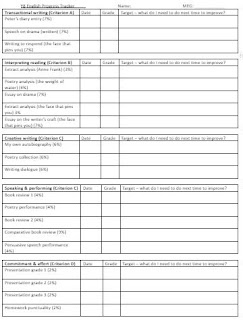
Back when I was a new teacher, I was having trouble motivating a class. My very wise mentor, Chris Campbell, told me to show them the success . I started doing this, and I noticed engagement go up, behaviour improve and students progressing. Now showing students their success can take many forms: displays of great work; cascading good practice through precise praise; messages home; feedback; peer reviews; and so on. I'll do blog posts about some of those at other times. What I want to write about here is showing them success over time .  You might call these progress passports, or assessment trackers, or success sheets . Whatever you call them, the essential part is it's a sheet that is easily accessible to students where they record their marks from assessments. Rather like this: For those classes using exercise books, I have them glue it in the inside front cover; for those using Chromebooks, I have them pin it onto their bookmark bar.  Over the course of the year, this beco...

Drama - a tool for engaging students in any subject

Image
OK, so I'm an English teacher, thus it's pretty easy to get drama into the class. However, I'm not just talking about acting out the texts we study.  Oh no.  Do you have to teach your students to use the passive voice?  OK, so after you have taught the form of the grammar point, set up a crime scene in class, and have them role-play being CSI, awarding points for every correct usage of the passive (e.g. "Buzz Lightyear may have been stabbed with the highlighter sir"). Yet, these kind of role-plays aren't limited to the Language departments. I was doing some training in a bilingual school outside Madrid and persuaded the Geography teacher to give this ago. Walking down the corridor the next day, he dashed out of his room, dragged me in and I was treated to a dramatic rendering of weather patterns: some students were playing the cold front, others area of high pressure, still more storm clouds. It was amazing! Forget the students: I swear I learned more about w...

Jenga! - a metaphor for how writers use tension

Image
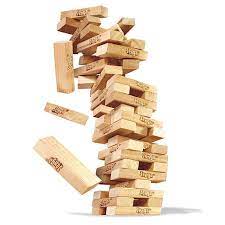
 I love finding ways to get games into the classroom (if you've read any of my other posts, you may have noticed). It is a great way to immediately amp up the students' engagement and energy levels. Many of the others I've written about - beep, bingo, taboo - can work in any subject. This one, I'm afraid, is purely for those Literature teachers among us... Jenga is a tense game. Therefore, I use it as a metaphor for tension in a text. I literally get the students to play Jenga as we read a tense moment of a text. Favourite moments for this include: Romeo & Juliet Act 3 Scene 5; the bit with Candy's dog in Of Mice and Men ; and when Fi gatecrashes the wedding in KE Salisbury's the face that pins you . As I'm reading I call people up to take a turn. The other students will get massively distracted, but at this point you pause (maybe while a student has half pulled out a brick) and ask the students if they are enjoying the lesson. "Yes!" they ...

Taboo! - a fun way to preteach or recap subject terminology

Image
So you're probably familiar with the word game (not the hideous 1990's alcopop) where one player describes a word and others have to guess it. This is a fantastic game for the classroom, in any subject : it brings loads of energy to the class; practices students' communication and recall skills; embeds key terminology; and, most importantly, gets the students engaged in each other's learning. There's loads of ways to do this, but here's how I play it with large (20+) classes: - divide up the students into teams of 3 or 4; - one player from each team comes to the front; - I show them all the same word (this is important); - in silence, they return to their groups; - I count down "3,2,1,Go!" and they have to explain the word to their groups; - the first person to shout out the correct answer, wins a point for their group. It's worth you, as the teacher, standing in the middle of the room for this, as close as possible to all groups, to avoid accusa...

Questioning: Agree, Challenge, Extend

Image
 Questioning is a core part of teaching. Yet, as you badger away at an individual student, drilling down to see what they know and how deep their learning goes, how do you involve the rest of the class? One finger = agree Students in agreement with the answer/statement/opinion raise one finger. Two fingers = challenge Students who disagree with or want to challenge an answer can signal with two fingers. This is great - how often have you asked another student (or a series of students) only to hear the same opinion as the first student you asked? This way you can immediately jump to the dissenting voice. Three fingers = extend (or build, as I've also seen it called) Students who agree, but for different reasons than stated, or who want to extend the answer, can signal with three fingers. Train your classes to do this as students answer. Suddenly, you can see where the whole class is, and suddenly they are all participating and thus have an even greater reason to invest in listening ...

Bingo! - a great active listening activity for any classroom

Image
 Obviously, you know how to play Bingo. So, how to use it to engage your students? Well, I like it for when I either a) have to show a longer video or b) have to read a long text with the class. Playing Bingo thus motivates them to pay attention and scaffolds them to identify key information. It's really no different than giving them a list of questions to answer, except that: 1. You are making a game of it and 2. By creating different Bingo cards you can actually increase the number of questions you can ask. There's loads of variations here: you could have students create their own cards or make them for them; you could have them listen for facts, quotations or types; the possibilities and combinations are endless. Just don't forget to reward the winners...

Mingles - get students talking to one another

Image
 Have you ever been on a training session or team building activity where the organisers have kicked things off with an ice-breaking activity called Find someone who...  ? You know, the one where you have to talk to the other participants to find out who has a tattoo, who has back-packed around Australia, who can play guitar. (Tutors, this is great beginning of the year activity, especially if you have vertical tutor groups.) Anyway, this is basically a version of that. I call it a mingle ; it could be called an information exchange. Maybe you know it by another name. Let's say you are planning a lesson and have to give the students a huge amount of information. You could give them a hand out, which they will promptly not read or simple lose; you could dictate it and have them take notes (don't get me wrong - there's a place for this) or you could try a mingle.  Give each student a list of questions and a piece of information. That piece of information answers ONE of the ...

Beep! - an engaging reading activity for any topic

For my first post, the ultimate time-efficient reading game: Beep! It's super simple. As you read a text out loud to the class, you make deliberate mistakes e.g. you say Calcium Oxide instead of Calcium Carbonate; you swap Chile for China; you muddle etre and avoir . The students must follow along in their own copies and shout "Beep!" if/when they spot the mistake. Keep a score (you can also deduct points for premature beeping). Any one student who dominates (e.g. that sole native speaker in a class of language learners), make them the scorer or even get them to take over the reading and mistake making. This works on many levels: for a start, it's fun in way that reading a large chunk of text often isn't. However, in order to play students must read along with you. How often do we suspect/know that half the class has drifted off while you read aloud, even if you get the students to take turns? Beep gets them reading word for word! Finally, you can of cours...